RetraBurn Official Website › Blog › Chromium At 7 mcg
Chromium At 7 mcg Is A Nutrient, Not A Dose
One row on this panel carries an amount of its own, a percentage, and arithmetic anybody can check in ten seconds. It is also about a twenty-eighth of the smallest amount the Cochrane review assessed. Both of those statements are correct, and reading only one of them is how a mineral row gets misunderstood.
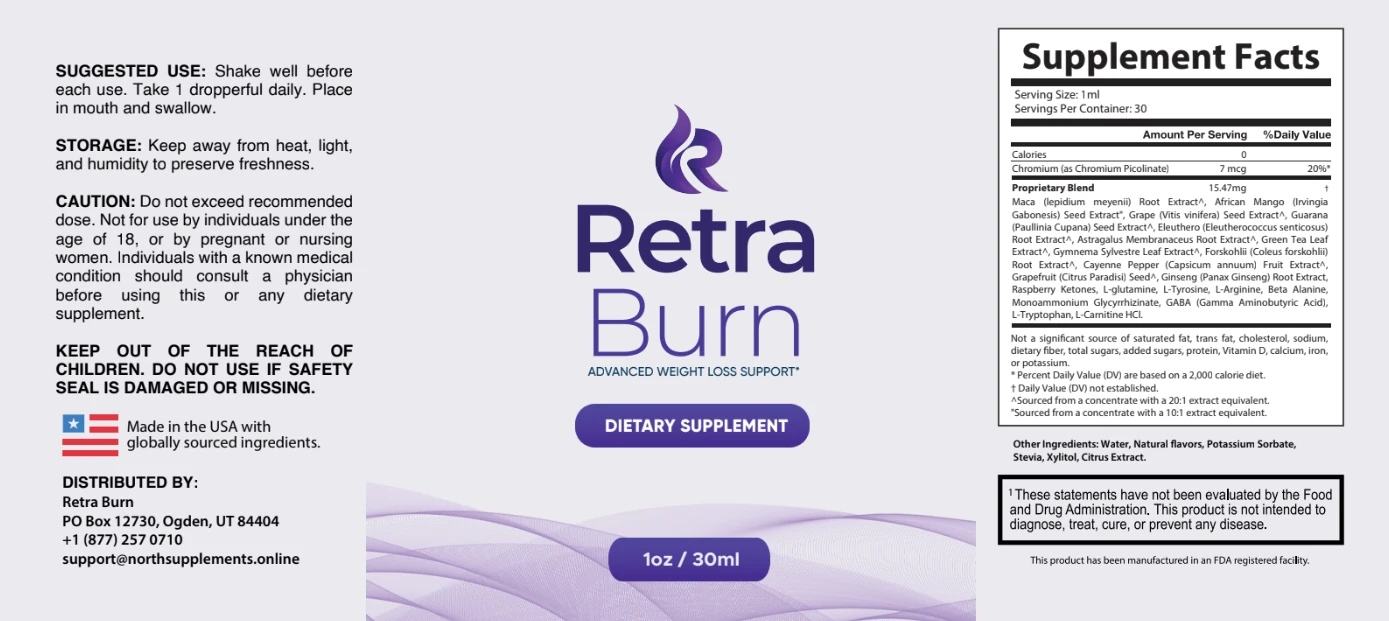
- Chromium is an essential trace mineral with a Daily Value of 35 micrograms on a Supplement Facts panel.
- 7 mcg is exactly 20 per cent of that, and the printed percentage is correct.
- The Cochrane review of chromium picolinate pooled 200, 400, 500 and 1,000 micrograms a day over twelve to sixteen weeks.
- It found a difference of about 1.1 kilograms and described the effect as of debatable clinical relevance on low-quality evidence.
- A nutrient declaration and a research dose are two different things, and this row is the first of them.
What chromium is and what it does
Chromium is an essential trace mineral. It appears in a wide range of foods in small amounts, including broccoli, whole grains, meat and some fruit, and deficiency in people eating an ordinary diet is rare.
Its accepted role is in carbohydrate and lipid handling, which is why it turns up on metabolism labels rather than on, say, joint labels. The reference value used on a Supplement Facts panel for adults is 35 micrograms a day, and a panel expresses any amount as a percentage of that figure under the federal labelling rule.
Trace means trace
Micrograms are easy to misread. A microgram is a thousandth of a milligram, so the entire Daily Value for chromium is thirty-five thousandths of one milligram. Chromium rows are therefore always going to look small beside botanical rows, and that is a property of the mineral rather than a criticism of a formula.
The one row on this label you can check
Most rows on most supplement panels cannot be independently verified by a reader. This one can, because it carries an amount and a percentage of a published reference value, and the two have to agree.
| Figure | Value | Where it comes from |
|---|---|---|
| Daily Value for chromium | 35 mcg | The reference value used on a Supplement Facts panel for adults |
| Amount on this label | 7 mcg | Printed on the panel, second row |
| Percentage printed | 20% | 7 divided by 35, which is exactly a fifth |
| Does the arithmetic check? | Yes | Independently, with nothing taken on trust |
One of the two numbers on this panel, and the only one that can be verified against a published reference value.
Seven divided by thirty-five is one fifth. Twenty per cent is what the panel prints. The row is internally consistent, the form of chromium is named in brackets, and nothing about it requires trust.
That is worth pausing on, because it is genuinely uncommon. A great many panels in this category carry percentages that do not reconcile with the amounts printed beside them, and checking the reconciliation takes ten seconds.
What the Cochrane review actually pooled
The Cochrane review of chromium picolinate for overweight or obese adults is the highest-quality single piece of evidence this ingredient has, and its findings are specific enough to be quoted rather than summarised.
It pooled randomised trials of chromium picolinate at four dose levels: two hundred, four hundred, five hundred and one thousand micrograms a day. Trial durations ran twelve to sixteen weeks.
The pooled difference against placebo was about 1.1 kilograms. The reviewers rated the evidence low quality and described the effect as of debatable clinical relevance.
| What Cochrane pooled | Daily amount | Multiple of the 7 mcg row |
|---|---|---|
| Lowest arm in the review | 200 mcg | About 28 times |
| Second arm | 400 mcg | About 57 times |
| Third arm | 500 mcg | About 71 times |
| Highest arm | 1,000 mcg | About 143 times |
The trials ran twelve to sixteen weeks. The pooled difference was around 1.1 kilograms, on evidence the reviewers rated low quality.
Two features of that table are worth naming. The lowest arm in the review is already twenty-eight times the amount on this label. And the effect did not obviously grow with dose across the range, which is not the pattern you would expect if the mineral were doing something powerful at the top end.
The distance between the two, in multiples
Here is the sentence this post exists to make precise. Seven micrograms of chromium is a correct and useful nutrient declaration. It is not the amount at which anybody found an effect on body weight, and it was never presented as one by the people who did the research.
The mistake worth avoiding runs in both directions. Reading the 20 per cent figure as evidence of a weight effect borrows a result produced at twenty-eight to a hundred and forty times the amount. Reading the small figure as a fault treats a nutrient row as though it were meant to be a treatment.
- As a nutrient contribution: a fifth of the daily reference value, printed accurately, in a named and well-absorbed form.
- As a dose studied for body weight: far below the lowest arm of the review, so the review's finding does not transfer.
- As a marker of label quality: a point in this label's favour, because the arithmetic reconciles and the form is named.
- As a reason to buy: no. The chromium row is the most checkable thing on the panel and the least likely to be doing the work a metabolism formula is sold on.
Read the RetraBurn panel with both numbers in front of you
Chromium at 7 mcg and 20% of the Daily Value, plus one declared blend of 15.47 mg covering 21 more. The panel is reproduced in full on this website, with 60 days from shipment behind any order.
Two bottles $158 · six bottles $294 · 60-day money-back guarantee
Order RetraBurn On The Official Website1 ml a day · 30 servings a bottle · lot RET-26/TH-2877
Why the form on the label is picolinate
Chromium appears in supplements in several forms and picolinate is the commonest. Picolinic acid is a chelating agent, and chelated chromium absorbs more readily than chromium chloride, which was the form used in older work and is poorly taken up from the gut.
That is why the research base is largely a picolinate research base, and it is why a label naming the form in brackets is doing something useful. A panel that prints chromium and stops has left out the one detail that decides which literature applies.
What the form does not change
Better absorption of a small amount is still a small amount. The form question and the dose question are independent, and answering the first one well does not move the second.
The other literature, which is about blood sugar
Chromium's weight literature is the famous one and it is not the largest one. A second body of work looks at glycaemic control, mostly in people with type 2 diabetes.
A meta-analysis of chromium and glycemic control covers that ground, and a dose-response review of chromium and body composition in type 2 diabetes sits between the two questions.
Those studies are worth knowing about for two reasons. They are conducted in a specific population, which means their findings do not automatically transfer to a general buyer. And they were run at supplemental doses rather than nutrient doses, which puts them on the same side of the gap described above.
For a general reader, NCCIH's page on weight control and supplements is the plainest account of where chromium sits among the things sold for this purpose.
Why a small chromium row is still a reasonable thing to print
It would be easy to end a post like this with a verdict, and the verdict would be wrong.
A formula can include a nutrient at a nutrient level for perfectly sensible reasons. Chromium is involved in carbohydrate handling, it is cheap, it is well tolerated at these amounts, and a fifth of the daily reference value is a contribution rather than a gesture. None of that requires the mineral to be the engine of anything.
The failure mode is not the row. It is a marketing sentence that leans on chromium's research reputation while the panel carries a nutrient amount, and the defence against it is the ten-second check at the top of this page.
Read the amount, read the percentage, and confirm they agree. Then look up the dose the research used. If the label figure is orders of magnitude smaller, the row is a nutrient declaration, and a nutrient declaration is a perfectly honest thing for a panel to carry as long as nobody is selling it as something else.
Five questions worth asking of any chromium row
None of this is specific to one brand. Chromium appears on a large share of this shelf and the same five questions sort the labels quickly.
- Is an amount printed, in micrograms, with a percentage beside it?
- Do the two reconcile against a 35 microgram reference value?
- Is the form named? Picolinate, chloride, polynicotinate and yeast-bound chromium are not interchangeable.
- Is the amount in the region the trials used, or in the region of the Daily Value? Those are two different places.
- Does the marketing lean on a research finding the printed amount cannot reach?
On the panel this website reproduces, the answers run: yes, yes, picolinate, the Daily Value region, and the pages here are written so that the fifth answer stays no. The supplement facts page prints the row as it appears on the bottle, and the rest of the panel sits inside a single declared blend that is a ceiling rather than a dose.
References
- Tian H, Guo X, Wang X, et al. Chromium picolinate supplementation for overweight or obese adults. Cochrane Database Syst Rev. 2013;2013(11):CD010063. PMID 24293292. https://pubmed.ncbi.nlm.nih.gov/24293292/
- Vajdi M, Khajeh M, Safaei E, et al. Effects of chromium supplementation on body composition in patients with type 2 diabetes: a dose-response systematic review and meta-analysis of randomized controlled trials. J Trace Elem Med Biol. 2024;81:127338. PMID 37952433. https://pubmed.ncbi.nlm.nih.gov/37952433/
- Asbaghi O, Fatemeh N, Mahnaz RK, et al. Effects of chromium supplementation on glycemic control in patients with type 2 diabetes: a systematic review and meta-analysis of randomized controlled trials. Pharmacol Res. 2020;161:105098. PMID 32730903. https://pubmed.ncbi.nlm.nih.gov/32730903/
- Weight Control. National Center for Complementary and Integrative Health, National Institutes of Health. https://www.nccih.nih.gov/health/weight-control
- Nutrition labeling of dietary supplements. 21 CFR 101.36. Electronic Code of Federal Regulations, Office of the Federal Register. https://www.ecfr.gov/current/title-21/chapter-I/subchapter-B/part-101/subpart-F/section-101.36