RetraBurn Official Website › Supplement Facts
Supplement FactsRetraBurn Supplement Facts: Serving Size and Panel
One RetraBurn serving is 1 ml, with 30 servings in each bottle.
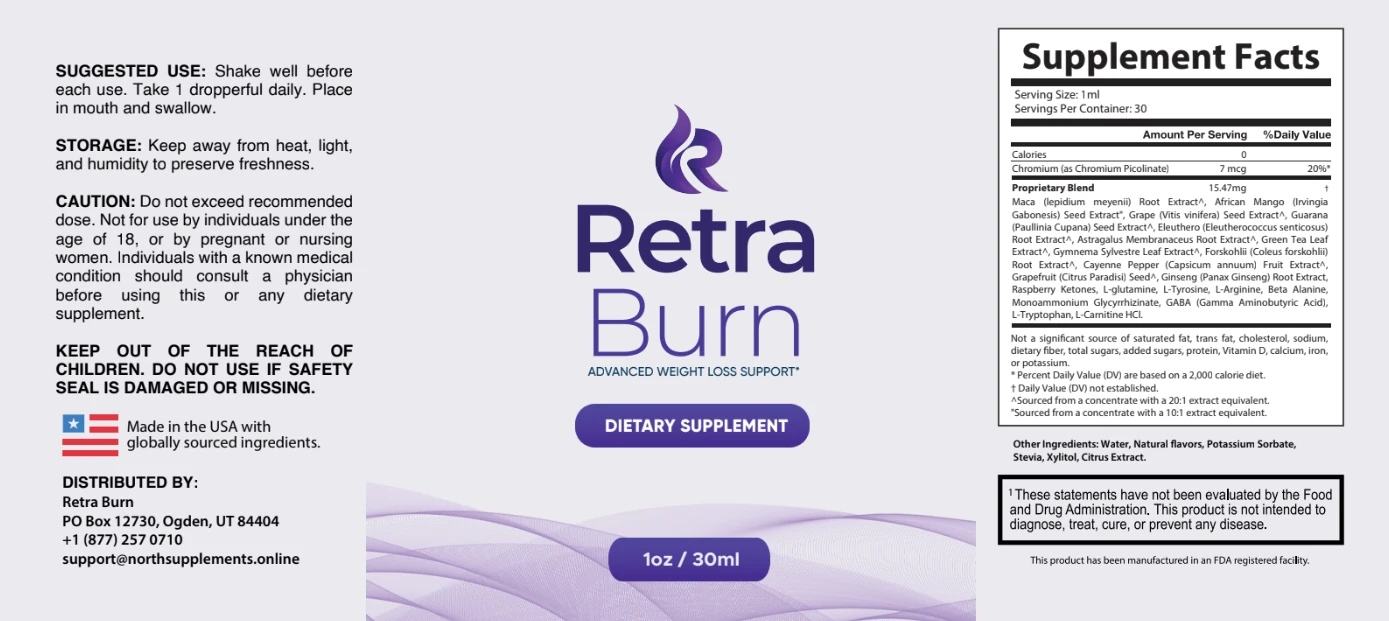
The panel shows zero calories, chromium picolinate at 7 mcg (20% of the Daily Value) and one 15.47 mg proprietary blend with 21 named members.
The panel reproduced exactly, then read line by line: what each column is for and what thirty servings adds up to.
The RetraBurn panel, exactly as printed
Reproduced so this page can be held against the bottle that arrives.
| Row | Amount per serving | % Daily Value |
|---|---|---|
| Calories | 0 | – |
| Chromium (as Chromium Picolinate) | 7 mcg | 20% |
| Proprietary Blend | 15.47 mg | † |
Serving size 1 ml. Servings per container 30. The dagger marks a row for which no Daily Value has been established. The chromium row’s Daily Value carries the panel’s own footnote marker, and that footnote reads: “Percent Daily Value (DV) are based on a 2,000 calorie diet.”
The 21 blend members, in the panel's own order. One declared weight covers all of them and no split appears between them.
| Blend member, as printed | Extract mark |
|---|---|
| 1. Maca (Lepidium meyenii) Root Extract | 20:1 concentrate |
| 2. African Mango (Irvingia gabonensis) Seed Extract | 10:1 concentrate |
| 3. Grape (Vitis vinifera) Seed Extract | 20:1 concentrate |
| 4. Guarana (Paullinia cupana) Seed Extract | 20:1 concentrate |
| 5. Eleuthero (Eleutherococcus senticosus) Root Extract | 20:1 concentrate |
| 6. Astragalus membranaceus Root Extract | 20:1 concentrate |
| 7. Green Tea Leaf Extract | 20:1 concentrate |
| 8. Gymnema Sylvestre Leaf Extract | 20:1 concentrate |
| 9. Forskohlii (Coleus forskohlii) Root Extract | 20:1 concentrate |
| 10. Cayenne Pepper (Capsicum annuum) Fruit Extract | 20:1 concentrate |
| 11. Grapefruit (Citrus paradisi) Seed | 20:1 concentrate |
| 12. Ginseng (Panax Ginseng) Root Extract | no extract mark |
| 13. Raspberry Ketones | no extract mark |
| 14. L-glutamine | no extract mark |
| 15. L-Tyrosine | no extract mark |
| 16. L-Arginine | no extract mark |
| 17. Beta Alanine | no extract mark |
| 18. Monoammonium Glycyrrhizinate | no extract mark |
| 19. GABA (Gamma Aminobutyric Acid) | no extract mark |
| 20. L-Tryptophan | no extract mark |
| 21. L-Carnitine HCl | no extract mark |
10 entries carry the caret for a 20:1 concentrate, African mango alone carries the mark for a 10:1 concentrate, and 10 carry neither because they are not plant extracts.
Other ingredients, as printed: water, natural flavors, potassium sorbate, stevia, xylitol, citrus extract.
The footnotes, as printed:
- “Not a significant source of saturated fat, trans fat, cholesterol, sodium, dietary fiber, total sugars, added sugars, protein, Vitamin D, calcium, iron, or potassium.”
- “Percent Daily Value (DV) are based on a 2,000 calorie diet.”
- “Daily Value (DV) not established.”
- “Sourced from a concentrate with a 20:1 extract equivalent.”
- “Sourced from a concentrate with a 10:1 extract equivalent.”
How to read each line of the RetraBurn panel
Six lines, and the last one is the easiest to misread at speed.
Serving size, and why it is the first number that matters
1 ml, which the suggested-use line calls one dropperful. Every amount below it on the panel describes that millilitre and nothing else. A figure taken from a panel without its serving size attached has lost the only context that made it comparable.
Servings per container, which turns a panel into a purchase
30. This is the number that converts a label into a diary: thirty servings at one a day is thirty days, so a bottle is a month and a pack is a number of months. It is also the figure to check the dropper against, because a bottle finished in three weeks was not being drawn to the serving on the panel.
The calories row, and why a zero is worth printing
A millilitre of sweetened water carries nothing to declare, so the row reads zero and the long footnote underneath rules out saturated fat, trans fat, cholesterol, sodium, fibre, sugars, protein, vitamin D, calcium, iron and potassium in one sentence. That footnote converts a set of empty rows into a set of declared zeroes, which is a different and better thing.
The chromium row, which is the only one with two numbers
7 mcg in the amount column and 20% in the Daily Value column. The Daily Value for chromium is 35 micrograms, a fifth of which is exactly seven, so the percentage is arithmetic rather than a rounding. The form is named too: chromium picolinate, which is the form almost every published trial used.
The proprietary blend row, and what a dagger means
15.47 mg in the amount column and a dagger in the Daily Value column, pointing at the footnote saying no Daily Value has been established. That is a statement about chromium's neighbours rather than about their quality: most botanicals and several amino acids have no reference intake to express a percentage against.
The two footnote markers that share one symbol
This panel uses a star-shaped marker twice, for two different footnotes. Beside the chromium percentage it points at the line saying Daily Values are based on a 2,000 calorie diet. Beside African mango in the blend list it points at the line about a 10 to 1 extract equivalent. Both footnotes are printed and both are correct; the symbol is simply doing double duty, which is worth knowing before reading the blend list quickly.
What the RetraBurn blend row is required to carry
Two obligations, both met, and one figure the rule leaves with the manufacturer.
A proprietary blend is a legal construction rather than a marketing one. The labelling rule for a Supplement Facts panel allows a manufacturer to group ingredients under a single name and declare one weight for the group, provided two conditions are met.
The members must be listed, and they must be listed in descending order of predominance by weight. The total weight of the blend must be declared. The regulation setting that out is public and short, and it is the reason a reader can learn anything at all from a row that looks like a wall of names.
This panel satisfies both. All 21 members are printed, in order, with their extract marks attached, and 15.47 mg appears in the amount column. What the rule does not require is the split between the members, and that is the figure this label keeps.
Two things follow for a reader. The order is information: maca is heavier than African mango, which is heavier than grape seed, and L-carnitine at the end of the list is the lightest thing in the bottle. And the total is a ceiling: no member can exceed it, which is what makes any comparison with published research possible without knowing the split.
- It tells you every member by name, 21 of them.
- It tells you their order by weight, heaviest first.
- It tells you the total, 15.47 mg, which caps every one of them.
- It keeps the individual weights, which is permitted and is what the word proprietary means on a panel.
The RetraBurn bottle in whole numbers
Seven figures that follow from two numbers and a servings count.
| What | How much | How it is worked out |
|---|---|---|
| Liquid in a bottle | 1 oz / 30 ml | The container size printed on the front panel |
| Servings in a bottle | 30 | At 1 ml a serving |
| Days a bottle covers | 30 | At the label dose of one a day |
| Chromium across a bottle | 210 mcg | 30 servings of 7 mcg |
| Blend across a bottle | 464.1 mg | 30 servings of 15.47 mg |
| Blend across the two-bottle pack | 928.2 mg | Sixty servings, which is sixty days |
| Blend across the six-bottle pack | 2,784.6 mg | A hundred and eighty servings |
Arithmetic from the panel's own two figures and its servings-per-container line. Nothing here is a dose recommendation.
Two of those rows are worth pausing on, because they are the figures a buyer actually spends money on.
Four hundred and sixty-four milligrams is the whole blend in a month, shared 21 ways. Even the six-bottle pack, which is half a year of daily servings, carries less than three grams of blend in total. Those are the numbers behind a purchase, and they are worth having in mind when the per-bottle price is being compared against a single-ingredient capsule.
Two hundred and ten micrograms is the chromium in a month. For scale, the Cochrane review of chromium picolinate pooled trials running at 200 to 1,000 micrograms a DAY, so a whole bottle of this carries roughly one day of the smallest dose that review assessed. That is a comparison rather than a criticism: the panel presents its chromium as a fifth of a Daily Value, which is exactly what it is.
The other ingredients line on the RetraBurn label
Six items in small type, and on a liquid they are most of what is in the bottle.
Underneath the panel, in smaller type, the label prints: water, natural flavors, potassium sorbate, stevia, xylitol, citrus extract. Six items, and on a liquid product they account for almost the entire volume of the bottle.
That line is the difference between a supplement panel and a full ingredient list. The panel above it carries what the product is sold for. The line underneath carries what makes it a liquid a person will swallow: a base, a preservative, two sweeteners and two flavour components.
It is also the line to read first for anyone avoiding a specific substance, because sweeteners and preservatives appear here rather than on the panel. Xylitol is the one worth knowing about for a reason unrelated to the person taking it: it is seriously toxic to dogs, so a bottle belongs in a cupboard rather than on a low shelf in a house with one.
Honest label analysis: what the RetraBurn panel settles and what it leaves open
Three settled questions and one open one, and why the open one turns out not to change the answer.
Three questions are settled by this panel outright, and one is left open. Stating which is which is the whole job of this section.
Settled: how much chromium, and in which form. 7 mcg as chromium picolinate, 20% of the Daily Value, arithmetic exact. Settled: which twenty-one things are in the blend and in what order of weight. Settled: how much blend there is in total, 15.47 mg a serving.
Open: how that total divides. Maca could be most of it or a tenth of it, and the label gives no way to tell. Every member's individual amount is therefore known only as a maximum.
What makes the open question workable is that the maximum is small enough to answer with. The trials behind these ingredients used 500 mg of forskohlii extract, 600 mg of gymnema, 300 mg of EGCG and two grams of carnitine a day, and none of them is reachable inside 15.47 mg however it is divided. So the split, while genuinely missing, does not change the conclusion. The full comparison is set out on the home page under honest dosage analysis.
The credit due here is real and is worth saying in the same breath. A label that declares its blend total, names every member in order and footnotes both of its extract ratios has given a reader more to work with than most of this category does, and it is the reason this page could be written at all.
RetraBurn panel questions
What is the serving size of RetraBurn?
1 ml, which the label calls one dropperful, taken once a day. The container holds 30 of them.
How much chromium is in RetraBurn?
7 mcg per serving, as chromium picolinate, which the panel gives as 20% of the Daily Value. The Daily Value for chromium is 35 micrograms, so the percentage is exact rather than rounded.
What is in the proprietary blend?
21 named members sharing one declared weight of 15.47 mg. They are printed in descending order of weight, starting with maca root extract and ending with L-carnitine HCl. The full list is reproduced above.
Why does the blend row have a dagger instead of a percentage?
Because no Daily Value has been established for the ingredients in it. A percentage column can only be filled where a reference intake exists, and most botanicals and several amino acids have none.
Does the RetraBurn label say how much of each blend ingredient there is?
It gives the total for the blend and the order of the members by weight, which is what the labelling rule asks of a proprietary blend. The split between the twenty-one is the part the rule leaves with the manufacturer.
How much blend is in a whole bottle of RetraBurn?
464.1 mg, which is 30 servings of 15.47 mg. A bottle also carries 210 micrograms of chromium in total across the month.
Is there sugar, alcohol or caffeine in RetraBurn?
No sugar and no alcohol. The sweeteners are stevia and xylitol and the calories row reads zero. Caffeine is present in whatever amount guarana seed extract contributes inside the shared blend, which cannot be read off the label.
Sources for the RetraBurn panel page
The labelling rule, and the trials whose doses the arithmetic above is compared against.
- Nutrition labeling of dietary supplements. 21 CFR 101.36. Electronic Code of Federal Regulations, Office of the Federal Register. https://www.ecfr.gov/current/title-21/chapter-I/subchapter-B/part-101/subpart-F/section-101.36
- Tian H, Guo X, Wang X, et al. Chromium picolinate supplementation for overweight or obese adults. Cochrane Database Syst Rev. 2013;2013(11):CD010063. PMID 24293292. https://pubmed.ncbi.nlm.nih.gov/24293292/
- Asbaghi O, Fatemeh N, Mahnaz RK, et al. Effects of chromium supplementation on glycemic control in patients with type 2 diabetes: a systematic review and meta-analysis of randomized controlled trials. Pharmacol Res. 2020;161:105098. PMID 32730903. https://pubmed.ncbi.nlm.nih.gov/32730903/
- Godard MP, Johnson BA, Richmond SR. Body composition and hormonal adaptations associated with forskolin consumption in overweight and obese men. Obes Res. 2005;13(8):1335-43. PMID 16129715. https://pubmed.ncbi.nlm.nih.gov/16129715/
- Gaytan Martinez LA, Sanchez-Ruiz LA, Zuniga LY, et al. Effect of Gymnema sylvestre administration on glycemic control, insulin secretion, and insulin sensitivity in patients with impaired glucose tolerance. J Med Food. 2021;24(1):28-32. PMID 32460589. https://pubmed.ncbi.nlm.nih.gov/32460589/
- Kapoor MP, Sugita M, Fukuzawa Y, et al. Physiological effects of epigallocatechin-3-gallate (EGCG) on energy expenditure for prospective fat oxidation in humans: a systematic review and meta-analysis. J Nutr Biochem. 2017;43:1-10. PMID 27883924. https://pubmed.ncbi.nlm.nih.gov/27883924/
- Talenezhad N, Mohammadi M, Ramezani-Jolfaie N, et al. Effects of l-carnitine supplementation on weight loss and body composition: a systematic review and meta-analysis of 37 randomized controlled clinical trials with dose-response analysis. Clin Nutr ESPEN. 2020;37:9-23. PMID 32359762. https://pubmed.ncbi.nlm.nih.gov/32359762/
Order RetraBurn and check the panel against the bottle
Every row on this page is reproduced from the printed artwork, and there are 60 days from shipment to decide whether the bottle matches it.
Two bottles $158 · six bottles $294 · 60-day money-back guarantee
Order RetraBurn On The Official Website1 ml a day · 30 servings a bottle · lot RET-26/TH-2877