RetraBurn Official Website › Blog › A Blend Total Is A Ceiling
A Blend Total Is A Ceiling, Not A Dose
A proprietary blend with one weight under it is fully compliant and frequently misread in both directions. It is not a secret, and it is not a dose either. What it is, is a number nothing in the blend can exceed, and that turns out to be enough to do most of the arithmetic worth doing.
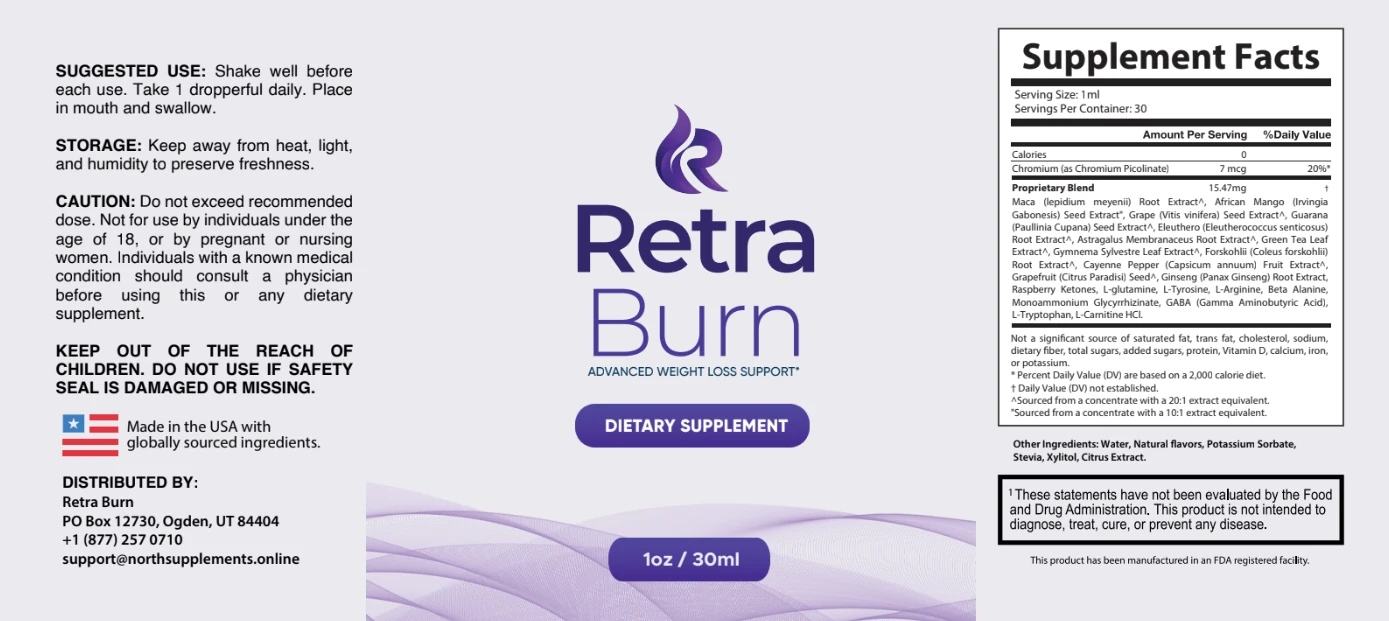
- A proprietary blend declaration has to carry the TOTAL weight and the members in descending order of weight. It does not have to carry the split.
- That total is a ceiling: no single member of the blend can weigh more than the whole of it.
- A ceiling is enough to compare a label against a published trial, which is the whole point of reading one.
- Descending order is the second piece of free information, and almost nobody uses it.
- A label with no total at all supports no comparison of any kind, which is a different and worse position to be in.
What the labelling rule actually requires
The federal rule for a Supplement Facts panel is 21 CFR 101.36, and the paragraph on proprietary blends is shorter than most people expect.
A group of ingredients may be declared together under a name the manufacturer chooses. The declaration has to give the total weight of that group. It has to list every member by name. The members have to appear in descending order of predominance by weight. And that is the end of the requirement.
What the rule does not ask for
It does not ask for the split. There is no obligation to say that the first name is nine milligrams and the last is a hundredth of one, and no supplement in this category volunteers it.
It also does not ask for a standardisation marker, an extract ratio, or a species confirmation. Those appear on better labels as a choice rather than as compliance, and where they do appear they are worth reading.
Why the rule is written that way
The stated purpose is to let a manufacturer keep a formulation from a competitor while still telling a consumer what is in the product. Whether that trade is a good one is an argument older than the rule. What matters at the shelf is that a blend declaration is lawful and ordinary rather than evasive, and that reading it as a scandal will mislead you just as badly as reading it as a dose.
Three kinds of panel, and what each one lets you do
Labels in this category fall into three groups, and the difference between them is not quality so much as what they let a reader calculate.
| What the label prints | Can you compare it with a study? | What you can work out |
|---|---|---|
| A milligram figure against every ingredient | Yes, directly | Whether each row reaches the amount its own research used. |
| A blend total, with the members named in order | Yes, against a ceiling | That no member exceeds the total, so every trial dose can be set against one number. |
| A list of names and no weights at all | No | Nothing. The formula cannot be compared with any published study, in either direction. |
Three kinds of panel, and the middle one is where most of this category's better labels sit.
The jump that matters is between the second row and the third. A label with a blend total gives you a fixed number to work with. A label with a list of names and nothing else gives you a vocabulary lesson.
That is worth saying because the two look similar at a glance. Both print a long list, both use the word blend, and only one of them has a figure under it.
Why a ceiling is worth having
Here is the property that makes the arithmetic possible. If twenty-one ingredients are declared together at a total of fifteen milligrams, then no one of those ingredients weighs more than fifteen milligrams. That follows from the declaration itself and needs no assumption about the split.
So every published trial dose can be set against that one number, and the comparison is valid for every member of the blend at once. It is a conservative comparison in the product's favour, because it credits any single ingredient with the entire weight of the blend, which cannot be true for more than one of them and is not true for any of them.
Three things a ceiling settles immediately:
- Whether a trial dose is even in reach. If the studied amount is measured in grams and the ceiling is measured in tens of milligrams, the answer is no, whatever the split.
- Whether the question is worth pursuing. Where the ceiling is close to the studied dose, the split starts to matter and is worth asking the seller about.
- How to read a claim built on an ingredient's reputation. A famous botanical inside a small ceiling is a famous name rather than a studied amount.
The arithmetic, done once
This website sells a product whose panel declares 15.47 mg for a blend of 21, so the worked example below uses that figure. The method is the same on any label.
| Ingredient | What the trials used | Against a 15.47 mg ceiling |
|---|---|---|
| Coleus forskohlii extract | 500 mg a day for twelve weeks | The whole blend is about a thirty-second of it |
| L-arginine | 4 g a day and above | The whole blend is about a two-hundred-and-fiftieth of it |
| L-glutamine | 30 g a day for fourteen days | The whole blend is about a nineteen-hundredth of it |
| L-carnitine | 2,000 mg a day, where the curve flattens | The whole blend is about a hundred-and-thirtieth of it |
Each right-hand cell assumes the entire blend is that one ingredient, which it is not. Twenty-one share the figure, so every real distance is larger.
Four rows, four orders of magnitude, and one conclusion that does not depend on the split at all.
The forskolin trial gave 250 milligrams of a 10 per cent extract twice daily for twelve weeks. The L-arginine dose-response meta-analysis located the blood-pressure effect at four grams a day and above. The glutamine pilot used thirty grams a day for a fortnight. The dose-response analysis of thirty-seven carnitine trials put the maximum effect at two thousand milligrams a day.
None of those numbers is in dispute and none of them was chosen to be unflattering. They are simply the amounts at which the findings were produced.
See the whole RetraBurn panel with the ceiling printed on it
Two declared amounts, 21 names in the order the label prints them, and both extract footnotes reproduced. One dropperful a day, 30 servings to a bottle, and 60 days from shipment to change your mind.
Two bottles $158 · six bottles $294 · 60-day money-back guarantee
Order RetraBurn On The Official Website1 ml a day · 30 servings a bottle · lot RET-26/TH-2877
Descending order is information too
The second half of the rule is the half nobody uses, and it is free.
Members of a blend must be listed in descending order of weight. So the first name is the largest component and the last name is the smallest, and the position of an ingredient on that list tells you something the manufacturer did not choose to tell you.
Read a blend list backwards once and the effect is immediate. An ingredient printed on the front of the bottle that turns up nineteenth of twenty-one is being sold to you at a weight below eighteen other things you were not told about.
A worked reading
On the panel this website reproduces, maca root extract is first and L-carnitine HCl is twenty-first. Gymnema sits eighth, raspberry ketones thirteenth and the licorice compound eighteenth. None of those positions carries a number, and all of them carry a rank.
Ranks are less than amounts and considerably more than nothing. They tell you which end of the blend a manufacturer put its money into, and they are checkable against the bottle by anyone who can count.
Four ways a total can still mislead you
A ceiling is useful and it is not a guarantee. Four caveats belong with it.
- A declared weight is a statement made at manufacture. It describes what went into a batch. It is not an assay of the bottle in your hand and not a potency guarantee at the end of shelf life.
- An extract ratio is not a dose. A 20:1 concentrate is twenty parts of plant reduced to one part of extract. It describes concentration, and a milligram of a 20:1 extract is still a milligram.
- The trials used specific materials. Standardised to a named marker, from a named species, at a named part of the plant. A blend member sharing a common name with a trial's material is not necessarily the same substance.
- Small is not the same as inert, and it is not the same as unsafe either. A ceiling tells you an exposure is limited. That cuts in whichever direction the ingredient's own literature points.
What to do when you meet one
The practical routine takes about four minutes with a label and a search engine.
- Find the total. If there is none, stop: no comparison is available.
- Count the members. Twenty-one sharing a figure is a different proposition from three.
- Pick the two or three ingredients the marketing leans on hardest.
- Look up the dose their published trials used. Meta-analyses and dose-response reviews state it in the abstract more often than individual trials do.
- Put the studied dose beside the total. If the total is orders of magnitude smaller, the split is irrelevant and you have your answer.
- Read the list backwards and note where the headline ingredient sits.
One general finding is worth carrying into that routine. A meta-analysis of herbal medicines for weight loss is the umbrella view of this whole category, and its conclusion is that the effects are small and the evidence is mostly low quality even at the doses the trials used. The arithmetic above is therefore not the only reason to be modest about a blend.
What a blend declaration is not evidence of
This post is an argument about arithmetic and it would be easy to read it as an accusation. It is not one, and the difference matters.
A proprietary blend is lawful, ordinary, and used by a large part of this shelf. A label that prints a total, names every member and lists them in declared order has complied with the rule and then done the extra thing that makes comparison possible. That is more than a list of names with nothing underneath it, and the sellers who print nothing are the ones this method cannot reach at all.
So the fair statement about a panel like the one this website reproduces has two halves. The disclosure is above average for the category. The amounts are far below what the research used. Both are true, neither cancels the other, and a reader who takes only the half that suits them has misread the label in a new direction.
The full comparison, ingredient by ingredient with each trial dose beside it, is on the ingredients page. The panel itself is reproduced row by row on supplement facts, and the seven checks that turn this into a routine are on choosing a metabolism supplement.
References
- Nutrition labeling of dietary supplements. 21 CFR 101.36. Electronic Code of Federal Regulations, Office of the Federal Register. https://www.ecfr.gov/current/title-21/chapter-I/subchapter-B/part-101/subpart-F/section-101.36
- Godard MP, Johnson BA, Richmond SR. Body composition and hormonal adaptations associated with forskolin consumption in overweight and obese men. Obes Res. 2005;13(8):1335-43. PMID 16129715. https://pubmed.ncbi.nlm.nih.gov/16129715/
- Shiraseb F, Asbaghi O, Bagheri R, et al. Effect of l-arginine supplementation on blood pressure in adults: a systematic review and dose-response meta-analysis of randomized clinical trials. Adv Nutr. 2022;13(4):1226-1242. PMID 34967840. https://pubmed.ncbi.nlm.nih.gov/34967840/
- de Souza AZ, Zambom AZ, Abboud KY, et al. Oral supplementation with L-glutamine alters gut microbiota of obese and overweight adults: a pilot study. Nutrition. 2015;31(6):884-9. PMID 25933498. https://pubmed.ncbi.nlm.nih.gov/25933498/
- Talenezhad N, Mohammadi M, Ramezani-Jolfaie N, et al. Effects of l-carnitine supplementation on weight loss and body composition: a systematic review and meta-analysis of 37 randomized controlled clinical trials with dose-response analysis. Clin Nutr ESPEN. 2020;37:9-23. PMID 32359762. https://pubmed.ncbi.nlm.nih.gov/32359762/
- Maunder A, Bessell E, Lauche R, et al. Effectiveness of herbal medicines for weight loss: a systematic review and meta-analysis of randomized controlled trials. Diabetes Obes Metab. 2020;22(6):891-903. PMID 31984610. https://pubmed.ncbi.nlm.nih.gov/31984610/